Friday, December 19, 2014

Translation/Localization Industry Forecast 2015

(Originally published in the Moravia blog)

Global Brands Will Turn to Single-Sourced Language Solutions

Our friends at localization industry think tank Common Sense Advisory recently posted a question to their blog: “Can LSPs Become the Exclusive Language Service Vendor for Their Clients?” From their own research, the answer was, paraphrased, “It’s a long shot.” Just 15 percent of the enterprises that they studied chose a single-source solution to their translation and localization needs. But the characteristics of who that minority group of brands were is important to note.
  1. They are well-experienced buyers of language services.
  2. They need suppliers that continue to prioritize innovation, drive, and scalability in their services provision.
  3. They require vendors that can deliver comprehensive, multilingual, and round-the-clock services to meet their diverse demands.
As the localization industry reaches maturity, top companies feel comfortable abandoning multivendor strategies as a way to protect themselves from insolvency or performance risks. Moreover, they understand — as the CSA report underscores — that managing multiple vendors entails a lot of internal investment in staff and processes, which is entirely contrary to corporate goals that seek to reduce the costs of too much infrastructure and personnel.
So not only can we expect to see more global companies turning to single-sourcing in 2015, we can expect more vendors to follow the lead of companies like Moravia, Welocalize, and Lionbridge by investing in the “program-based not project-based” model that moves strong SLAs and KPIs to the fore.

For Better and Worse, Smartling Will Disrupt Business as Usual

It’s not every day that a translation company excites so much interest beyond the borders of industry conferences, but five-year-old, New-York-based Smartling is doing just that. Smartling is a cloud-based SaaS workflow solution for processing and delivering multilingual content, combining machine and human translation. With more than $65 million USD already raised, according to ZDnet, Smartling is the company every language services provider will have to deal with in 2015 in one way or another.
The Good
Smartling is spending a lot of OPM (Other People’s Money) to promote translation in areas that our industry has never ventured before (such as underwriting National Public Radio’s Marketplace in all of the major U.S. markets) and speaking at events for VCs and technology startups.

The Bad
All that glitters is not gold, goes the saying, and it’s relevant to Smartling, too. Despite their claim to the contrary, proxy-based translation systems are not innovative. Those have been around for a while, catering mostly to less mature and inexperienced localization service buyers, especially new brands in the mobile space like Uber and GoPro. It is definitely not an enterprise solution.

The Ugly
Smartling’s revenue model is not scalable and seems to be suffering from constant “improvement.” Like many startups that start with free or freemium models, it has not yet settled on the most profitable revenue structure. I predict that Smartling will have to start increasing their subscription price or their pass-through per-word fees. It is unlikely that either choice will be enough to make the company’s financial model viable for the long haul.

Strong-Performing Multinationals Will Push Multilingual Supplier Demands

I have been on the record for years as saying that how the localization industry performs is a key indicator of economic performance. Take a look at Fortune Magazine's “2015 Investor’s Guide: Don’t buy this, buy that — Foreign Markets.” It affirms my sense that demand for the localization industry will be strong by recommending that investors buy into European multinationals and the growth of so-called frontier markets. Add to that the established technology stalwarts like Oracle, Apple, RedHat, Google, and Microsoft as well as Common Sense Advisory’s own predictions on global language services demand and we have all the signs for a strong growth year.

These are our bets for 2015, but let us hear from you. Add your own perspective on the 2015 forecast in the comments section below.

Sunday, August 24, 2014

"Donate a Workout" for Translators without Borders

Inspired by the Ice Bucket Challenge, and by my new biking outfit (courtesy of Global textware), I'd like to invite all Language Service Professionals to donate one workout to Translators Without Borders during the next few weeks before the end of the Summer.

I rode 25 km today and donated $5.00 per km (www.translatorswithoutborders/Donors). Monetize your exercise in minutes, miles, kilos, yoga positions, steps and convert them into euros, dollars, yens, reais or any other currency and help raise money for many worthy causes.

Please share.

Wednesday, July 17, 2013

Expert Advice for Globalizing Medical Devices | Qmed

Interview originally posted in Qmed.com

When it comes to tapping the potential of emerging markets, medical device firms have just scratched the surface. One reason for this is that commercializing a medical device product in a foreign market can be challenging. The difficulty in doing so depends on the product in question as well as the end market being targeted. Here, Renato Beninatto, chief marketing officer of Moravia, a globalization and localization firm, provides general background information and advice for device companies seeking to commercialize products internationally.

There are essentially three major regions that provide opportunities for U.S. medical device manufacturers:
  1. The European Union: To introduce a medical device in every country in the European Union requires localizing it, translating and adapting relevant materials, to the 26 official languages of the European Union.
     
  2. Asia: Countries like Japan, China, and Korea pose specific challenges from a localization perspective, especially for software developers because those countries use what we call ‘double-byte languages.’  Every character they use occupies two bytes instead of one, like Latin characters do. “This requires the software that is embedded in the medical device to be internationalized by software engineers. This is not work done by linguists,” Beninatto says. “It is adapting the product so that it can handle different character sets, date formats, currency formats, and sorting orders.” This type of work can be outsourced but is something that medical device companies should plan on as early as possible.
     
  3. Latin America: This market uses only two languages, Portuguese and Spanish, but is also a significant growth market for device firms.
The concept of globalizing first requires preparing the product for localization and then converting content into multiple languages. A best practice is to do as many languages as possible at the first pass. The preparation work required before translating content to a different language is essentially the same as prepping it to be translated into 20 languages. Because medical devices are regulated, Beninatto says, translating text can be a painstaking process. “Even a minor change you do to the documentation has to go through an expensive and laborious approval process. The best approach is to do it right the first time.”

While machine translation has progressed over the years, it is largely unsuitable for translating important documentation. “There is a joke I heard many years ago: 'Machine translation is great but is somewhere from four and 400 years from perfection.' That joke still seems to apply with every passing year.” Customizing translation software can yield “decent results” for things like knowledge bases, but the success of it depends highly in the language pair. “There are situations and contexts where machine translations could be used—especially those that are more conversation in tone rather in scientific. But I would still always advise partnering with a specialist company when working with machine translation,” Beninatto says.

Software Matters


Software development is undergoing a major change from a traditional waterfall model to an Agile methodology. In the software methodology, it would take anywhere from 12 to 18 months to have a complete development cycle. “You knew exactly where you would do translation in that process. You would have finished the whole development documentation, sent it to translation, incorporated the content back, did functional and regression testing and so on, and then you would release the product,” Beninatto says. “You could either do a simultaneous shipment, all languages at the same time, or a scattered release.”

The world today is different, thanks to smartphones and Google. “Now change is happening all of the time and software is continually updated. This is the world of Agile development and translation becomes part of this process,” Beninatto explains. The cost of doing internationalization work becomes increasingly expensive, the longer you wait to start because of the need to go back and correct code. “When somebody is designing a product, they should anticipate that it will be global.”

An example of what not to do is to embed strings into the code. “Let's say you use concatenated strings to generate text,” Beninatto says. “In the code, you have an 'if' followed by a variable. When something happens, 'then' you introduce another variable. This structure is a problem because the order of the words varies based on the language. For instance, in German, you would put the verb at the end of a clause rather than in the middle.” For that reason, it is a best practice to internationalize the code as early as possible.

Brian Buntz is the editor-in-chief of MPMN and Qmed. Follow him on Twitter at @brian_buntz.  

Friday, June 28, 2013

Feminism & Cheeseburgers? Yawn. It's All About The Click!


(This blog entry was originally published in the Moravia blog)


Translation can be really unsexy at times. Sure, it can be good for a viral video that pokes fun at the Germans. (Wat are you zinking about?) And, yeah, occasionally some diplomat really flubs it, resulting in a whole lot of angry Russians. (We're looking at you, Hilary.) But, well, mostly translation is about processing a whole lot of data through tools so advanced even Gene Rodenberry's Star Trek writers couldn't imagine it.

So when you're charged with getting customers excited about words, it's at least cool to gather them around some pretty visualizations of the data. Ooh. Ahh. Nice.

Size Matters

Curious myself, I asked the folks in our Production Group to give me a sense of the numbers. With clients that include Microsoft there's no doubt we're processing (and gratefully getting paid for) a lot of words each year. The answer: 371,162,387 words translated into 122 languages.

I'm a talkative guy. Really talkative. If, as Scientific American reports, the average male speaks 16,000 words per day I'm probably doing twice that. At my pace, it would take my mouth more than 30 years to push out that kind of volume.

Look A Little Closer

I asked my buddies at the Process and Technology Group (PTG) to take this deeper — to look at the body of source data and to do some word frequency analysis. For the test, here's what they did:

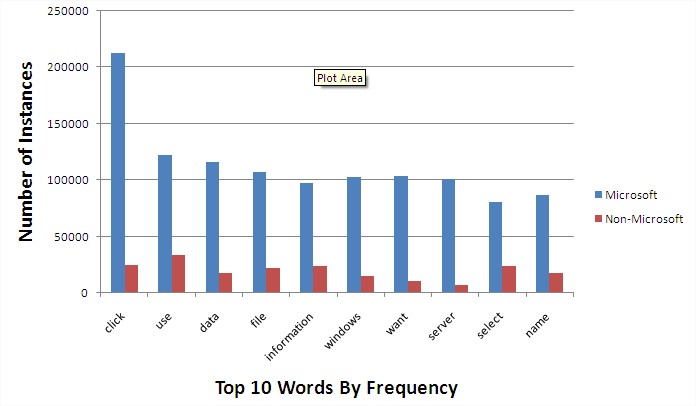
PTG took translation memories with approximately 24 million English words, of which 206,000 were unique (non-repetitive). They divided the total number into Microsoft projects and non-Microsoft projects. They then broke those down into most frequent, least frequent, and — for kicks — the longest words.

At The Top

Perhaps no surprise for Microsoft data, click appeared most frequently and far more so than among non-Microsoft projects.
top words moravia

At The Bottom

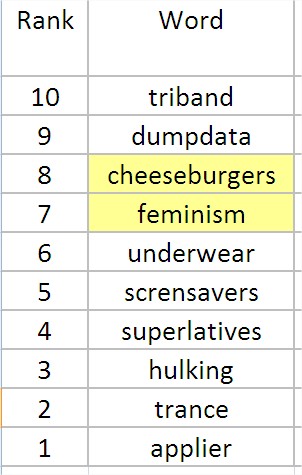
Of the 206,000 unique words, there were of course many that appeared just once in our projects. The results were humorous ... or telling. We'll leave those assessments to you.


infrequent words moravia

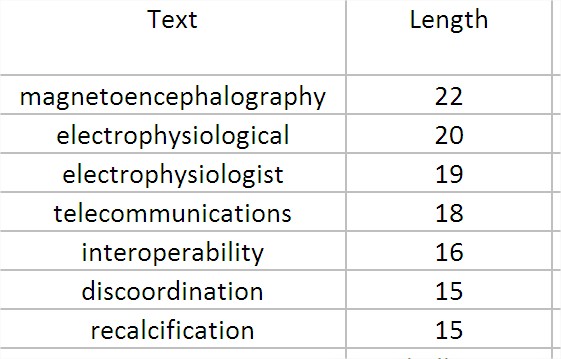
The Longest WordsWe were looking at English words, of course. Were this an analysis of German words, we'd have to wrestle with the likes ofRindfleischetikettierungsüberwachungsaufgabenübertragungsgesetz — 63 letters and, curiously enough, just lost from the German lexicon earlier this month because its reference, a law, was repealed. (Farewell, friend!) At just 22 letters, magnetoencephalography is a linguistic bargain.


longest words moravia

Industry colleagues, you're welcome to use the comments for a little size comparison. I've shown you mine; how about you show me yours?

Tuesday, January 15, 2013

Localization trends for 2013. No news, good news?

(This article was originally posted in the Moravia blog)

Every year, around December or January, I have written a blog entry with predictions and trends for the next year. We are now two weeks into the new year, and I didn't find anything special to write about 2013.

So, it ocurred to me that this might be a year when things are settling down. A year for evolution, rather than revolution. A period when trends tend to consolidate and take ground. There are five movements that have started sometime ago, but that I feel are now part of the gestalt of the localization business.
  • Content style is moving from formal to informal in all languages. Companies are not doing major rewrites of their manuals, but new products are written in a friendlier tone. Another way to put this: "All localization is marketing related."
  • The job of localization managers is expanding beyond language and culture. Global customer satisfaction and business requirements demand other activities like support, community moderation, usability adaptation, and local relevance. The relationship with vendors changes accordingly.
  • Voice and video content become more localization-friendly and language-aware, now that it actually became "normal" to use your voice to control your phone, car, computer and even your TV.
  • Continuous localization or on-demand translation becomes the norm, not the exception.
  • African languages appear on everybody's radar, especially when it comes to the localization of mobile devices and apps.
Of course, nothing prevents a revolutionary product like holographic telepresence for interpretation services or a pill that makes you speak Chinese from being launched this year or next, but it feels like 2013 will just be another good year for the language services industry.

Wednesday, December 14, 2011

What I expect for 2012

As the song goes, "it's the most wonderful time of the year". It's the time to make predictions.

Before going into my expectations for 2012, I took a look at what I wrote last year, and I believe that my predictions for 2011 materialized.

Content is indeed being served in smaller chunks and requiring faster turnaround times. There is more demand for multimedia translations such as video, and also for interpretation both on-site and over the phone. So voice was in fact more in demand in 2011.

Last week, LinkedIn announced that their website was now available in Indonesian, Malaysian, and Korean. Several other companies have done the same. Brazilian Portuguese was one of the fastest-growing languages, but also one with the most quality and delivery problems.

What didn't happen at the pace that I expected, was the number of mergers and acquisitions in the industry in 2011. There have been some, but no major mergers.

The topics that I expect to hear about in 2012 are more related to startups. There is going to be an increased focus on on-demand translations. Companies like Speaklike, MyGengo, Smartling, Translated.net, LanguageWire, Tolingo, and OneHourTranslation will be all over the place. Larger players will also offer their own solutions. Companies will be able to find efficiencies in moving down to smaller projects.

I also believe that we are going to be talking about marketplaces again. This sounds so 1999, but companies like Cloudwords and OpenBorder will be offering an online marketplace for translation companies to bid on projects of traditional buyers. Proz tried that before, but who knows... the times are different.

The automation of small project workflows, will require an increased productivity on the part of project managers. The most requested job in the translation industry will actually be project management, but the role of the project manager will shift more rapidly from closely managing resources to managing exceptions.

I don't think that the economy is in shape for many mergers and acquisitions. But we will hear about some of them happening. Companies like Welocalize and Transperfect still have plenty of cash, and there are companies for sale in the market. It is just a matter of finding the right price point.

Wednesday, September 14, 2011

From Managing to Monitoring - From Drops to Drips

After the recent IMTT Conference in Córdoba (Argentina), my friend Cecilia Piaggio was kind enough to offer me a ride to Rosario the next day. During the five-hour drive, we had a chance to talk about some changes that have happened in the translation industry in the past several years and to think about the changing roles of translators, project managers, LSP owners in a world where content is ubiquitous and streaming constantly.

She told me that one of the things that she noticed is that more and more clients were moving from the traditional project model — where files are dropped in an FTP server, work is done, and files are delivered again by FTP or e-mail — to a continuous flow of strings and small files that need to be picked up, processed and published within a short period of time. Or, as she aptly put it, we are moving from drops to drips.

If we combine this with the constant advance of automation of processes and repetitive activities with the use of tools like Plunet, XTRF, and Multicorpora, it becomes clear that the role of the project manager is also shifting. In fact, if you look at the performance of highly efficient companies like LanguageWire in Denmark, you will notice that project managers have become a lot more productive in the last few years. And the explanation for this is that instead of managing projects or drops, that traditionally require manual preparation and a lot of file shuffling, project managers can now focus on monitoring the process.

In other words, we are moving from active involvement in tasks to managing by exception. The project manager only interferes in a process when the systems show that something is not going according to plan. This allows a PM to work on many more projects, just monitoring his dashboard for red flags.

More projects and more automation lead to fewer human errors and higher yields. Good times!


Tuesday, September 06, 2011

Revenue Opportunities for LSPs

Innovation and new services are regular topics in my consulting engagements. My clients want to know how they can differentiate and increase their margins. They want to go beyond calling prospects and offering translation for cents per word.

Recently, while on-site at my clients, I happened to come across requests that I thought could become opportunities for starting new conversations with potential translation buyers. After all, calling a prospect to offer translation services is a losing proposition. To use the words of Anne-Marie Colliander Lind: to be successful in sales, you have to talk about activities that will generate translations, and not translation itself. Here are some examples:
  • Video subtitling. In the middle of my consulting session, a project manager asks permission to talk to the LSP owner about an urgent project that required subtitling in two languages. Using the traditional processes, the transcription, translation, and subtitling would have taken four days and cost $3,000.00. I introduced them to dotSub, a site that I first mentioned here back in 2007. In a few minutes we had an account and I walked them through how to do the job. Few hours later, the translation was ready and we downloaded the HD video to deliver to the client for no cost at all (except our effort). 
  • Tape transcription. Same scenario: PM brings a client's request for the transcription and translation of the recording of a Board Meeting that was held in English. Finding foreign language transcribers is not always easy, especially on short notice. Enters CastingWords, a crowdsourced web-based transcription service with fast turnaround and prices varying from $1.00 to $2.50 per minute. Low cost transcribers can also be found on Elance and other freelance sites. The result was that the transcription was done in 24 hours by native speakers and the translation was ready the next day. Point, set, match! 
  • Streaming content. Hot day, no air conditioning (you guessed, I was in Europe!), my client tells me that he recently lost an opportunity because his client had short sentences that needed to be translated within 5 minutes for the duration of a sporting event every Sunday. These were newsflashes and game statistics that needed to be broadcast in several languages and my client lacked the infrastructure and the linguistic resources to fulfill the need. The project never materialized. I explained to him that companies like SpeakLike specialize in this type of service, and that he could have outsourced the solution for as little as $0.06 per word, giving him enough room to mark it up and make a profit, without having to invest in the technology infrastructure.
The action item following these three events was clear: Productize the request and call potential buyers asking questions that will generate translations. 

So in the first case, the question could be: "Do you ever receive training videos in other languages that you need to share with your employees?" 

In the case of transcriptions, the LSP could call administrative assistants (or secretaries as they are still called in some countries) and ask if they ever have to transcribe audio from meetings in English (if you ever had to do it, you know it is a pain).

As for streaming content, any website that publishes news is a candidate for on-demand translation. Financial sites, sports associations or events, news organizations, all need to provide information fast and accurately. After all, news has as very short shelf life. In theory, a Czech hockey player in Canada might want to have his Twitter feed and news published in Czech, English, and French to satisfy his fan base.

Using creativity to transform project challenges into new and innovative products is a good practice. All you need to do is say yes to your client requests, and maybe give me a call.


Wednesday, August 10, 2011

Argentina, Holland, Russia, and Greece: Next Events

This week I am preparing presentations and topics for the next event season that is kicking off. I am particularly excited about four events:

  • The 7th Language and Technology Conference in Córdoba, Argentina, which kicks off on August 20th. I have been attending this event organized by IMTT since 2005, and it has consistently ranked among the best events in my opinion (Kirti Vashee and I also discussed it in a video conversation posted previously here). This time, the Cecis are taking a plunge and adding a Portuguese language track to the event, trying to congregate the two major Latin American markets under a single conference. A quick look at the program shows that the organizers have invested in high-caliber speakers with content that is extremely relevant to the translator community. If you are in Argentina, Brazil, Chile or Uruguay, there is still time to register and show up!
  • On September 9th, the Dutch Association of Translation Agencies is hosting their annual event called TMT - The Future is Here. This is my first time attending and speaking at the Dutch ATA, but I like their model of having one keynote and several workshops after it. Very hands on, very practical. The topics will be around tools, marketing/media, and post-editing.
  • Translation Forum Russia, September 23-25 in St. Petersburg, has just published its program with four tracks filled of high level content and great local and international speakers. Last year was my first foray into the Russian market and I find it to be vibrant and in clear expansion. The organizers were kind enough to ask me to keynote the event, but I am actually very interested in checking out some of the local business-related tracks. The event is in Russian and English and I hope that they provide me with a personal interpreter, like they did last year, so that I can enjoy the local sessions. Bert Esselink (the guy who wrote the book on localization), Luigi Muzii (who just published a book of his own), Alison Toon, Anne-Marie Colliander Lind, Doug Lawrence, Noël Muylle are the international speakers and Irina Alexeeva, Ekaterina Ryabtseva and Vladimir Fakov the local stars.
  • In November, ELIA - the association of which I am president - will be hosting its Networking Days in Athens. I am very involved with the program and I must say that, as usual, we will have a fantastic roster of speakers and unique topics of special interest for European LSPs. This time there will be a full track on Medical and Pharmaceutical translations. Among the confirmed speakers are Federico Garcea, from Microsoft MT; Mirko Plitt, from Autodesk; Artur Raczynski, from the EPO; and many others.
I will also be attending and presenting at Localization World, in Santa Clara, and Tekom, in Wiesbaden, both in October. These are much larger and customer centered events. I will be writing about them in another post.

Tuesday, June 28, 2011

European Patent: Almost There

European Union governments have been negotiating the issue of a single EU patent for decades. Taking advantage of the fast-track procedure – which came in with the Lisbon Treaty and allows a group of countries to go ahead with EU legislation even when not all 27 member states agree – Ministers met Monday and hammered out a so-called "general approach," which is the governments' position on a European Commission legislative proposal that will create a single patent for the EU. I have discussed this matter previously in this post about the creation of a European patent system.

Italy and Spain fear discrimination because patents would be filed only in English, French or German. The two countries have filed a legal challenge with the European Court of Justice (ECJ), arguing that the new enhanced co-operation procedure should not be used to bring in the patent system. In fact, efforts to get an EU-wide agreement on patents have been blocked for many years by language disputes and the lack of unanimity.

At the moment, the European patent requires validation in each member state, and a full translation of the patent in the official national language. The new single patent system is expected to be in place by 2013, and should cut the current €32,000 it costs to get a patent across the 27 EU countries (€23,000 only for translations) to €2,500 for the 25 countries participating in the project (all but Italy and Spain), and further down to €680 at the end of a 12-year transitional period. In the U.S., a patent filing costs about €1,850.

Implications for the Language Services Industry

This is not good news for LSPs, but companies have been preparing for sometime. In fact, RWS Holdings, the biggest patent translations company in Europe, mentioned in its 2010 Annual Report that "The thrust of our acquisition strategy since 2005 has been to target technical translation businesses which have zero exposure to any developments in the patent field."

Lingtech, the Danish company that developed machine translation solutions for patents into Scandinavian languages, saw its revenues dwindle since the London Agreement and was recently acquired by Kommunicera AB.

But not all is gloom.

  • Translations will still be required between English, French, and German, and in some cases into each European language. 
  • The expectation is that the number of patents registered in Europe will increase because of the cost savings. So the reduction in number of translations could be offset by the increase in the number of documents filed.
  • Asian countries file more and more patents every year. Those patents will need to be translated into European languages for filing. This means that there might be also a shift in the language pairs required for patent translations.
Even though I personally believe that the cost of translation is just a cost of doing business and that respect for linguistic diversity is a core EU value contained in the Charter of Fundamental Rights of the European Union, I think that the train has left the station and a Single European Patent will be reality LSPs will have to contend with.

Thursday, June 23, 2011

No One Wears Shoes Here

Last Sunday was Father's Day here in the United States and I spent the day catching up on my reading while the children played around me. Among a series of interesting articles and OpEds in BusinessWeek, Fortune, the New York Times, and other publications, I found an interesting column by Rana Foroohar in the Curious Capitalist section of Time Magazine called "Why the World Isn't Getting Smaller."

The spirit of the article is that globalization is not such a big thing as some of us want it to be, and — using Thomas Friedman's image — that the world is not that flat.

Rana points to some facts:

  • More than half of global trade, investment and migration still takes place within regions — much of it between neighboring countries.
  • Some 80% of global stock-market investment, for example, is in companies that are headquartered in the investor's home country.
  • Exports represent about 25% of the global economy.
  • Less than 20% of Internet traffic crosses national borders.
  • Only 2% of students attend a university outside their home country.

The author also discusses the fact that one of the effects of globalization is actually more demand for localized products as emerging markets now have money and confidence to call their own shots and demand for customized products and solutions.

My father was the son of a shoemaker from Italy and grew up in a small town in Brazil and he used to tell a joke that came to my mind as read this column. It's the story of two shoe salesmen who were sent to Africa to see if there was a market for their product. The first salesman reported back, “This is a terrible business opportunity, no one wears shoes here.” The second salesman reported back, “This is a fantastic business opportunity, no one wears shoes here.”

Whether the world is getting smaller or not doesn't really matter. The reality is that as countries become wealthier, populations start to demand products to meet their needs, and they want these products in their own language. So for the language services industry, I would say that the world is a fantastic business opportunity, no one speaks all languages here!


Tuesday, June 21, 2011

Three Takeaways from Localization World Barcelona

The European edition of Localization World ended last week in Barcelona with a record-breaking attendance of 550 participants from the supply and demand side of the language services industry. The program committee put together and excellent roster of speakers with extremely valuable content.

I was able to attend several sessions and I took note of three comments that I think are relevant for all the players in the language field:
  • Oleksandr Pysaryuk, from Research In Motion, indicated that LSPs might re-think traditional offerings and provide services around internationalization, user experience research, usability research, usability testing, acceptance testing, and local UI design. This is a clear message to LSPs who want to go beyond translation and talk about value-added services with their clients.
  • Derick Fajardo, from Nuance, in the panel that we shared about Online Bidding, mentioned a quote that he hopes will put him on the Wall Street Journal someday: "Cost rules, quality is assumed, but in the end, schedule wins." This statement confirmed a comment by Tim Young from Cisco in the morning keynote panel. When I asked him which of the several metrics that he tracked for his internal clients was the most important for them, he answered forthright: "On time delivery."
  • Danica Brinton (photo by
    Agnieszka Gonczarek)
  • Danica Brinton (photo), from Zynga presented some fascinating data about the impact that localization has in the adoption of games for this fast-growing company. But the interesting part for me was some practical information about the relative value of certain markets. Norway, with a population of less than 5 million, generates more revenue for Zynga than Indonesia, the country with 230 million inhabitants and the biggest number of Facebook users in the world. It is clear that other factors than number of internet users drive localization decisions.

Sunday, May 29, 2011

Google Translate API Deprecation Causes Commotion

In a post in the Google Code blog, among news of new APIs and other updates, Adam Feldman (APIs Product Manager) announced that the Google Translate API would be shut down according to its deprecation policy.

By clicking to the API page link we learn that "The Google Translate API has been officially deprecated as of May 26, 2011. Due to the substantial economic burden caused by extensive abuse, the number of requests you may make per day will be limited and the API will be shut off completely on December 1, 2011. For website translations, we encourage you to use the Google Translate Element."

The first reactions from the developer community were negative, as the tone and quantity of comments to the announcement indicate. On the language camp, the reactions fell in two groups: "I told you so"  and "Don't be evil, my eye!" (from the people that were skeptical about Google's good intentions of honest decision-making that disassociates the company from any and all cheating.)

I reached out to my contacts at Google to try to get an official position, but they declined to comment.

First, let's make it clear that Google Translate is not going away! The announcement is only about the API, and will affect programs that have incorporated it, like Trados, Wordfast, and DéjàVu, plus hundreds of smartphone apps that were developed on this platform. I will particularly miss the My-Translator plugin for Firefox.

What does this announcement mean to the language industry?
  • MT price will go up. The value of MT solutions like AsiaOnline and Systran will go up as developers will not have access to the free solution provided by Google (unless they resort to web scraping.)
  • Migration to Bing. Microsoft's MT solution doesn't cover as many languages and is not as good in as many domains as Google Translate, but it does the basic job well, specially for IT-related content. 
  • Google Translator Toolkit continues to be a good alternative to use translation memories in combination with MT. My guess is that the functionality of this tool will continue to improve, since this is the environment Google uses to localize its own applications.
  • Naggers will be empowered. The traditional arguments about confidentiality issues, quality of translation, misuse, working for free for a commercial entity will remain unchanged in the language industry. Now, the argument that Google can't be trusted will become part of the portfolio of reasons not to use Google Translate. 
I feel bad particularly for non-profit and practical integrations of the API that will be lost. I think that Google could just set up a price for the API to solve the problem of "abuse," even though I have a feeling that this is just a lame excuse.

As for me, I will continue to use it to read texts in languages that I don't understand.

Wednesday, May 04, 2011

SpeakLike and a New Category of LSP: The On-Demand Translation Vendor

I just saw a demo of SpeakLike and I was instantaneously brought back to a comment that I made in a recent post here on this blog: We never really talk about the future, we are only talking about a present in which we don't participate.

SpeakLike fits in an ever-growing category of companies that cater to web-based streaming content and small projects with fast turnaround times. Companies like MyGengo, Smartling, Translated.net, LanguageWire, Tolingo, and OneHourTranslation have slightly similar (or slightly different, if you prefer) approaches to address their client needs, but they all center around Project Management Automation, one of the strong industry trends that I have been talking about. I call this category of companies the On-Demand Translation Vendors.

SpeakLike was founded by Sandy Cohen, a serial technology entrepreneur, with the original idea of integrating existing off-the-shelf technologies to provide online interpretation services based on machine translation, speech-to-text and text-to-speech. Some of the early prototypes I saw some years ago worked better than the speech-enabled version of Google Translate does today. But as it often happens to innovators, Sandy was early to the party and the demand for these services was not there yet. But there was demand for real-time on-demand human-based translation of chat communication at the enterprise level. And that is what SpeakLike has morphed into.

What is exciting about this approach to translation, which lies between the traditional time-consuming Translation-Editing-Proofing method and the often vilified pure Machine Translation, is that it provides a browser-based environment for experienced freelance translators to work on fast turnaround documents or customer support online chats. It's like telephone interpretation for text.

Some of the features that I like about SpeakLike:
  • Interface. The translator interface is like an improved version of Facebook Translate. Along with the source text (sometimes images or PDFs), the translator gets relevant terminology, previous similar translations (translation memory) and Style Guide information that is specific to the client at hand, with data about tone and format.
  • Speed. The system is designed to provide translations as fast as humanly possible. This means turnaround times of minutes to hours instead of days and weeks. It is a system that is ideal for streaming content like news, financial data, and online support chat.
  • Price model. Translations are cheaper than what you would get from a traditional LSP, but margins are still attractive for the business because once a client is setup, all tasks are automated and the overhead is minimal. 
  • iPhone App. If you are in a foreign land and cannot understand a sign, you can take a picture of it and submit it to SpeakLike, where a human translator will translate the sign and send it back to you. It's a manned version of Google Goggles or Word Lens.
The challenge for SpeakLike, as well as for the other companies that I listed above, is adoption. With limited funds, these companies need to invest in sales or other forms of mass dissemination of their solution in order flourish.

Tuesday, May 03, 2011

Duolingo: Crowdsourcing at its Best for the Translation Industry

For the last month I have been reading tweets and notes about Duolingo as the place where "you learn a language and simultaneously translate the Web," but I kept postponing getting more information about it. As a good procrastinator, I figured that if this was really important, it would eventually make its way to me. Well... it did!

Ultan Ó Broin mentioned my name in his Blogos entry "The Future of Web Translation: Haters Gonna Hate" and I felt compelled to watch the video by Luis von Ahn, the inventor of Recaptcha, at a recent TEDx event at Carnegie Mellon University.

Duolingo does for translation what Flickr did for photography and what Wikipedia did for encyclopedias. It brings the knowledge of amateurs to do some work that only professionals could do. The advantage of Duolingo is that − unlike Facebook or Hootsuite, who also use community translation − the user learns a language in the process.

Crowdsourcing − the approach used by Duolingo − is the act of outsourcing tasks, traditionally performed by an employee or contractor, to an undefined, large group of people or community (a "crowd"), through an open call. The goal for Duolingo is to get 100 million people to translate the web into every major language for free.

The trade-off here, according to Luis, is that there are 1.2 billion people in the world learning a second language and they have to pay for it. With Duolingo, they will learn a language for free and translate the web in return. A really revolutionary and innovative concept.


According to Luis, using this approach, Wikipedia could be translated into Spanish in five weeks with 100,000 people or in 80 hours with one million individuals.

Who does this approach benefit? Everybody.

Who does it hurt?
  • Insecure translators who like to complain about things they can't control.
  • Rosetta Stone, Livemocha, Fluenz and other software-based language learning software.
  • Machine translation providers like AsiaOnline, PROMT and SDL, because Duolingo could be a faster/better solution.
Duolingo is a welcome addition to the arsenal of language solutions around the world. It is clearly a solution for making knowledge and information that would never be professionally translated available, especially in languages where the translator pool is insufficient for the amount of content that is available for translation. Watch out Google Translate!

Monday, April 25, 2011

Globalization German Style: 75% of Sales Come from Abroad

A new study by Ernst & Young analyzing the annual reports of the 30 German companies that compose the DAX (German Stock Index), indicates that three-quarters of sales for 28 of the 30 companies come from outside Germany.

The study also shows that − with the exception of the two banks in the index − international business grows faster in terms of revenues and number of employees than business in Germany. Companies reported 19% growth abroad, compared to 9% domestically. International sales for Adidas, for example, accounted for 95% of the total; and reached 91% at Linde.

The detailed study also shows that German companies have performed very well in 2010, with pre-tax profits almost doubling from the previous year to 87.3 billion euros.

It is interesting to compare the results from this study with last year's S&P 500 analysis of 250 American companies in which 46.6% of all sales in 2009 were produced and sold outside of the United States.

From a language services perspective, the message is clear: International business is good business and requires translation and localization. So, instead of talking about translations in your next sales call, learn to talk about what is going to generate translations in a larger business context.

Friday, April 15, 2011

Framing the Discussion about the Future of the Industry

Earlier this week in Budapest, during the MemoQ User Conference, I participated in a panel discussion about the future of the industry. It seems that this is a favorite subject in recent events and I suspect that people are so interested in what is going to happen either because they are bored with the present or because there is a sense of insecurity in the air.

At a dinner with Kirti Vashee in the Trastevere the previous week, David Orban, CEO of dotSub, gave me an inspiring quote by William Gibson: "The future is already here — it's just not very evenly distributed."

I couldn't resist and started using it the next day in a presentation to the students at LUSPIO. That quote helped me frame several of the ideas that are popping up in the global discussions about industry issues in events, associations, and online venues like LinkedIn and Twitter.

I particularly like that quote, because every time that a problem is raised, someone comes up with a story about a company that has already found a solution or is working on it. Combined with my favorite disclaimer that “The closer your vision gets to a provable future, the more your are simply describing the present. In the same way, the more certain you are of a future outcome, the more likely you will be wrong,” — which I took from The Visionary’s Handbook by Wacker & Taylor — William Gibson's axiom explains why we seem to be stuck: We never really talk about the future, we are only talking about a present in which we don't participate.

In a recent interview, Nassim Taleb, author of the Black Swan and one of the first to preview the collapse of the financial system in 2008, talks about the concept of "subtractive prophecy." He says that "to predict, you need to remove from the future what doesn't belong there because of fragility." This thought completes the triangle that I like to use in the recurring discussions of what will happen in the localization industry.
The questions that I pose myself are:
  • Is someone already doing it? (Description of the present)
  • Is it plausible that someone is already doing it or is the issue easily solvable with existing technology? (Provable future)
  • Do we really need it? (Subtractive prophecy)
Following these premises, here is what I think of the three favorite topics of the industry:

Machine Translation, My view is that it is a reality that is here to stay. It will improve over time and its uses will expand. It is not "evenly distributed" but it is widely available, and it is more of an ally than a foe to the language services space.


Standards. A laudable effort undertaken by organizations that have no power to enforce them. On the technology standards front, I think it is more likely that middleware will develop to broker conversions between translation memories and transfers between different content management systems. (I seem to have heard something about a product called Any2TM at memoQfest and ClayTablet already does some of it).


Crowdsourcing. A topic dear to translators who see it as a threat, as the encroachment of non-professionals into the language industry. Too late. People will do translations for free, just as you take pictures without the help of professional photographers. The reality is that there is more demand for translations than there are professional translators to handle them. Crowdsourcing -- like machine translation -- is just another way to address this market reality.

Thursday, March 31, 2011

Good News from Brazil

I just came back from a week in Brazil and I must confess that it felt good to read positive news about the economy for a change. Three things caught my attention, especially since I will be moderating a panel next month in the Think Latin America event in Silicon Valley.

From pyramid to diamond
  • Data on the growth of the middle class. The income class distribution in Brazil used to look like a pyramid, now it is diamond-shaped. The Brazilian middle class now represents 53% of the population or roughly 101 million consumers. The wealthier A and B classes represent 22% and the "poor" are now 25% of the country's population. 
  • Air travel versus Bus travel. Brazilians used to travel by bus, because it was cheap and convenient. But with the growth of the middle class and the arrival of low cost airlines like Azul and Gol, Brazilians now prefer to take a plane for interstate travel. In a country of continental dimensions, this means increased productivity, but also a huge burden on the infrastructure. The Porto Alegre airport, for example, has seen a 90% increase in traffic from 2005 to 2010.
  • Taxes. Brazilian authorities announced that tax revenues for 2011 were 19.7% above the same period in 2010, and that the February numbers were the highest ever for that month. This is the result of the increased economic activity in the country, although critics complain that tax revenue is growing faster than the economy, which grew 7.5% last year. 
If you add that the majority of the population believes that the economy will be better in 2011 than in 2010, you have the recipe for a perfect market to pursue.

A relevant factor for the localization community is the fact that according to an English Proficiency Index study by EF highlighted by the Lioness blog "Latin America has the lowest level of English proficiency of any region. Only Mexico and Argentina score above low proficiency."

So if you want to sell in Latin America, start localizing now!

Tuesday, March 01, 2011

Of LISA's Insolvency and Other Events

"As of 2011 February 28, the Localization Industry Standards Association (LISA) is insolvent. In spite of the financial constraints LISA faces as an organization, we are exploring ways to continue the association's good works for the industry."

With this short notice on their website, LISA announced what had been obvious for some of us, industry insiders for a while: The LISA model was unsustainable and obsolete. Since the formation of GALA and the successful series of events organized by Localization World, LISA had become irrelevant. IBM's withdrawal from LISA a couple of months ago was the coup de grâce.

I was always very fond of LISA. It was there that I made my first presentation to the industry. It was there found a buyer for Lazoski, Beninatto, my company in Latin America. It was there that I met my wife. And it was there that I forged strong relationships that I maintain to this date.

But I am not sad. The industry is much more mature than it was in 1990. Companies have many more choices, and the fragmentation of industry events is an unavoidable reality. Localization World and its separate specialty events like the upcoming Apps Go Global and Worldware Conferences cater to specific needs of the buyer and vendor communities without the requirement of a hefty membership fee.

GALA, which was originally created as a vendor-only association, is now trying to attract localization buyers to its membership, and will certainly pick up the crumbles from LISA. The industry must only avoid repeating the same mistakes and I certainly hope that GALA does not become another pay-for-play event organizer and remains true to its mission to promote the industry as whole.

As a conference-hawk, I have shared my views about industry events several times in this and other blogs. For a refresher, take a look at my posting about specialty events and at the video conversation I had with Kirti Vashee on the subject of events.

Sunday, February 13, 2011

Google Translate App for iPhone Censors Swear Words

WARNING: This post contains graphic language. Don't read it if you are too sensitive.

Since I bought an iPad for our home, my five- and eight-year old children have learned every imaginable swear word on YouTube by watching Lego videos and Justin Bieber parodies. After the initial surge in interest and the inevitable uncomfortable situations in public, they seem to have gotten over the potty mouth phase.

Last week, I installed the new Google Translate app on my iPhone and was impressed by the voice recognition in 15 languages and the accuracy of the translations. I actually thought that it would have come handy in a couple of situations in Korea and China, where there were no foreign language speakers around.

This weekend, one of my brothers from Brazil came to visit and we started to play with the Google Translate app. Just like when we were kids moving to a new country, the first phrases we used to test the functionality of our new toy were swear words. And this is where the big surprise came: Google Translate doesn't print swear words in English. But ONLY in English.

As you can see in the screen capture, every time we used the word fuck, it was replaced by ####.

Out of curiosity, and using a very scientific approach to the process, we went about testing offensive sentences expressed in other languages and translated into English. Interestingly, the app had no problem translating and printing the word fuck from other languages into English, as you can see from the screen captures below.

This makes me wonder what is behind this policy and who makes the decision to enforce it.
  • App Store policy against offensive language? If so, does this also happen in the Android version of the app?
  • Hypersensitivity of Americans to four-letter words? If so, does this also happen in the UK or Australian versions of the app?
  • Why does the "censorship" only applies when you speak the swear words? In fact, you can actually type them and the text will be translated fine.
In any case, this is just a funny thing. The tool itself is excellent and very practical. I have been able to dictate relatively long sentences with acceptable accuracy, especially for a free tool. No wonder it is already the number one download in the App Store.

If you have an iPhone, download the app today and test it with your language pairs.

The screen captures below were the result of speaking a sentence in a foreign language and having it translated into English using the voice recognition feature.